

The most expensive septic repairs are almost always preventable. Homeowners who catch the warning signs early can address issues for a few hundred to a few thousand dollars. Those who wait until the system fails completely face costs of $15,000 to $35,000 or more for a full replacement.
Here are the key warning signs of septic tank problems, what each one means, and what to do when you see them.
How Does a Septic System Work?
Before diagnosing problems, it helps to understand what your system is doing. Wastewater from your home flows through a main drain line into a buried septic tank. Inside the tank, solids settle to the bottom as sludge, oils and grease float to the top as scum, and partially treated liquid (effluent) exits through the outlet baffle into the drain field.
In the drain field, gravel and soil further filter and treat the effluent before it reaches groundwater. The system works quietly in the background for years with proper maintenance. When something goes wrong, it sends signals.
Knowing what those signals look like is the difference between a timely repair and a public health emergency.
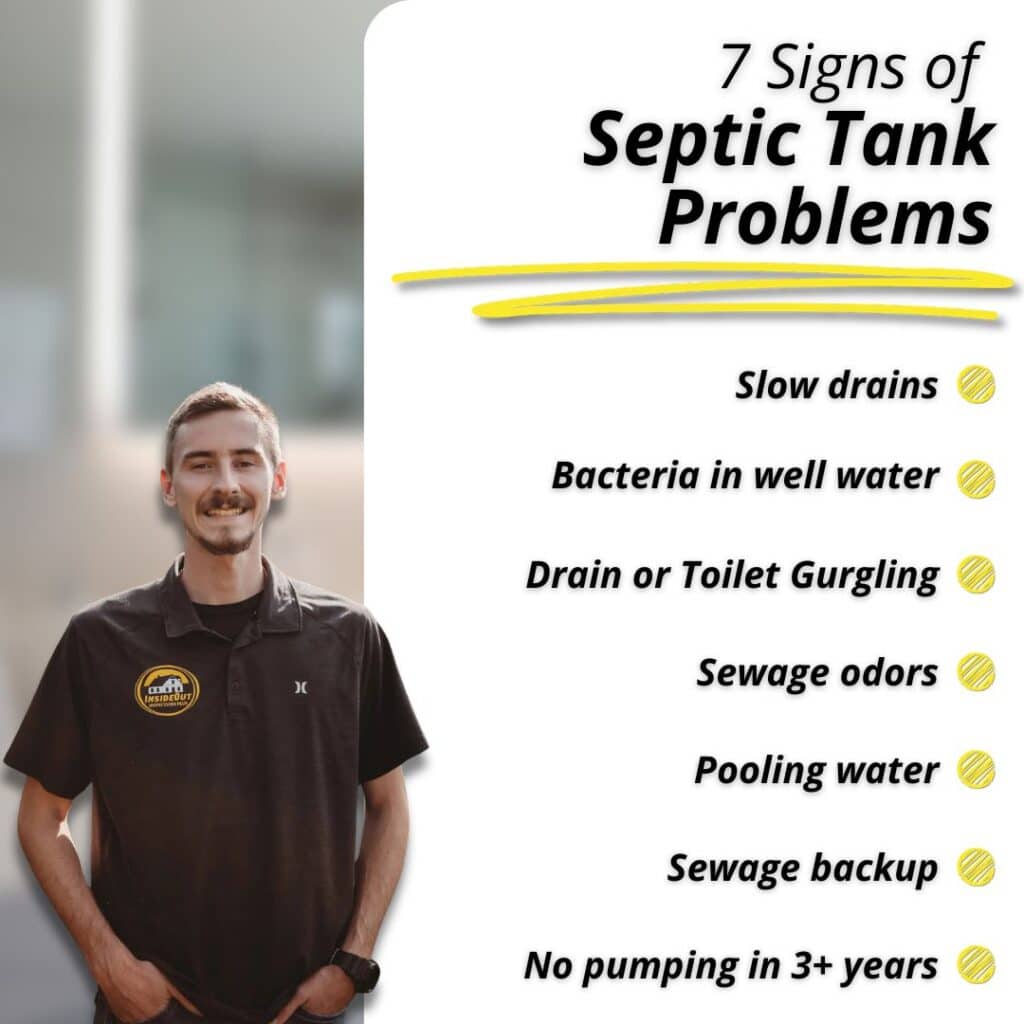
7 Signs of Septic Tank Problems
These issues don’t always show up in obvious ways. However, here are some common red flags to be on the watch for.
1. Slow Drains Throughout the House
A single slow drain is usually a localized clog in that fixture’s drain line. When multiple drains in your home slow down simultaneously, including sinks, showers, bathtubs, and toilets on different levels, the problem is almost certainly further downstream: a full tank, a failing drain field, or a blockage in the line between your house and the septic tank.
Do not confuse this with a single toilet that flushes slowly. System-wide slow drainage affecting multiple fixtures is one of the clearest early indicators of septic system stress.
2. Gurgling Sounds From Drains or Toilets
If your toilet gurgles when you run the washing machine, or your sink bubbles when you flush, the system pushes air backward through the drains. This happens when the tank is full, and pressure builds, when the outlet baffle is clogged, or when the drain field cannot accept effluent at the normal rate.
Gurgling sounds are often overlooked for months before homeowners connect them to a septic issue. Do not dismiss them.
3. Sewage Odors Inside or Outside
Septic systems are designed to keep odors contained. Bacteria inside the tank produce gases, including hydrogen sulfide (the rotten egg smell) and methane, which normally exit harmlessly through the roof vent stack. When you smell sewage inside the home, particularly in bathrooms or the basement, or outdoors near the tank or drain field, the system is venting where it should not.
Inside odors often indicate a vent pipe issue or a blockage that is causing gases to back up through plumbing traps. Outdoor odors near the tank or drain field indicate that wastewater is surfacing, which means the system is not containing or treating waste properly.
4. Wet Spots, Pooling Water, or Unusually Green Grass Over the Drain Field
Walk around the area above your drain field and tank after a dry period. If you see soggy ground, standing water, or patches of grass that are significantly greener and thicker than the surrounding lawn, effluent is surfacing.
The excess liquid acts like fertilizer and irrigation, but what it actually indicates is that your drain field has become saturated and is failing to absorb waste at the necessary rate.
Wet spots above the drain field are a serious failure sign. Keep children and pets away from the area. Surfacing wastewater carries pathogens, including E. coli and other bacteria that pose direct health risks.
5. Sewage Backup Into the Home
When wastewater backs up into toilets, floor drains, or shower pans, the system has reached a critical point. Lower-level fixtures back up first because they are closest to the main drain line. If sewage is coming up through a basement floor drain, the septic tank is likely full, the outlet baffle is blocked, or the drain field has failed entirely.
This is an emergency situation.
Stop using water in the home immediately and call a septic professional. Do not attempt to clean up the backup without proper protective equipment, as exposure to raw sewage carries significant health risks.
6. Nitrates or Coliform Bacteria in Your Well Water
Homes on septic systems often also rely on private wells. If your annual well water test shows elevated nitrate levels or the presence of coliform bacteria, and there are no obvious agricultural sources nearby, a failing septic system may be contaminating your groundwater.
The EPA notes that septic system failures are a significant source of groundwater contamination in areas without municipal sewer service.
Annual well water testing is recommended for all homes on private wells, and any positive result for coliform should trigger an immediate septic system evaluation.
7. Your Septic Tank Has Not Been Pumped in Three Years or More
This one is less visible but just as important. Septic tanks require pumping every three to five years to remove accumulated solids that do not break down. Skipping this maintenance allows sludge to build up to the level of the outlet baffle, where it is then pushed into the drain field and clogs the soil.
Once the drain field is clogged with sludge, it cannot be unclogged. The entire field must be replaced. If you do not know when your tank was last pumped, that is already a red flag. Schedule a pump-out and inspection immediately.
Warning Signs Do’s and Don’ts
| Type | Action | Reason |
| Do | Act early | Two or more symptoms together warrant immediate inspection because catching problems early can save tens of thousands in repair costs. |
| Do | Reduce water use | Shorten showers, stagger appliance use, and delay laundry since excess water strains an already stressed drain field. |
| Do | Call a licensed professional | Camera inspection, sludge testing, and soil evaluation require specialized equipment beyond DIY assessment. |
| Avoid | Digging or driving near the drain field | Soil compaction and physical damage to perforated pipes can result. |
| Avoid | Using septic “additives“ | No reliable evidence supports their effectiveness; they can disrupt the tank’s natural bacterial balance. |

What a Septic Inspection Covers
A professional septic inspection before purchasing a home or as part of regular maintenance evaluates:
- Tank integrity (cracks, corrosion, improper baffles)
- Sludge and scum levels relative to tank capacity
- Outlet baffle condition
- Distribution box function and effluent flow
- Drain field condition and soil absorption rate
- Evidence of surfacing effluent or groundwater intrusion
Related Questions to Explore
- How often should a septic tank be pumped? Most residential septic tanks should be pumped every 3-5 years, depending on household size and tank capacity. Larger households or homes with garbage disposals may need pumping every two to three years. Consulting with a licensed pumper after your first service gives you a baseline for your specific system.
- Can a failing septic system be repaired, or does it always need replacement? It depends on the failure type. Clogged inlet or outlet baffles, broken pipes, and full tanks are typically repairable. A failed drain field is almost never repairable: once the soil is clogged with sludge or biomat, a new field must be installed in a different area of the yard.
- What should I not flush or put down the drain with a septic system? The only things that should enter a septic system are human waste, water, and septic-safe toilet paper. Do not flush wipes (even those labeled “flushable”), feminine hygiene products, medications, or paper towels. Do not pour grease, coffee grounds, or harsh chemicals down drains.
- Does heavy rain affect a septic system? Yes. Heavy or sustained rainfall can saturate the soil around the drain field, temporarily preventing effluent absorption. If you notice slow drains or odors following heavy rain, that is a sign the drain field is under stress. It may resolve once the soil dries, or it may indicate the field is near the end of its useful life.
- How long does a septic system last? With proper maintenance and pumping, a well-installed septic tank can last 20 to 30 years or more. Drain fields typically last 20 to 25 years. Concrete tanks can crack over decades. Regular inspection is the best way to know your system’s current condition.
Get Your Septic System Inspected
Septic system problems do not resolve on their own. If you have noticed any of the warning signs above, or if you are purchasing a property with a private septic system, a professional inspection is the safest next step.
For sellers, a pre-listing septic inspection removes uncertainty from your transaction and gives buyers confidence. See our full range of inspection services or schedule an inspection today.
Conclusion
InsideOut Inspections Plus LLC includes septic system evaluation as part of our comprehensive home inspection services. Our inspectors are trained to assess tank condition, drainage performance, and potential drain field stress, giving you a clear picture of system health before you commit to a purchase or face an unexpected repair.
Call us or schedule online for an evaluation of your septic tank!
